


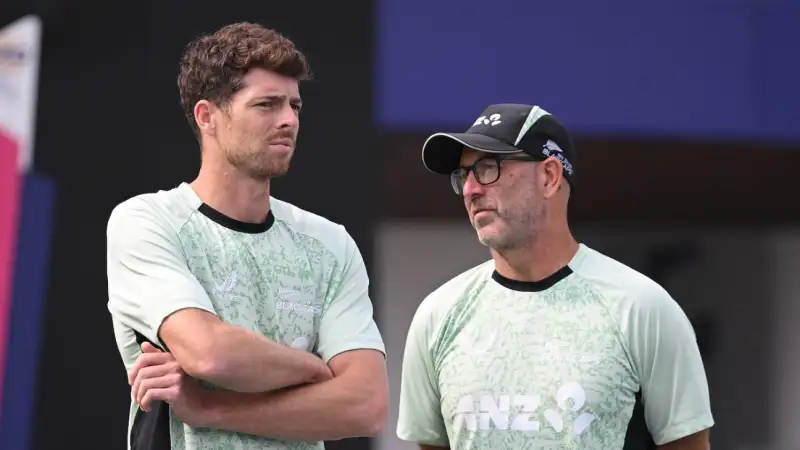
Mitchell Santner, the white-ball captain of New Zealand, declined a two-year contract offer from Adelaide Strikers in order to remain dedicated to the Black Caps’ international assignments. The 34-year-old spin-bowling all-rounder declined the offer, which is estimated to be worth nearly one million dollars over the course of two years, in order to prioritise his duties as a centrally contracted player and play Test cricket.
India is scheduled to play a complete series in New Zealand from October 22 to December 1, which will consist of two Tests. Subsequently, India will embark on a four-Test tour of Australia. Mitchell Santner decision was indicative of the conflicting pressures that centrally contracted players must navigate, as they must balance franchise opportunities with international availability and domestic Super Smash obligations.
Rob Walter, the coach of the New Zealand national team, expressed his profound admiration for Mitchell Santner dedication to the team in response to his decision.
Throughout the decision-making process, Walter maintained communication with Mitchell Santner and provided his assessment of the player’s character in light of the choices made.
Mitchell Santner had previously stated that his ambitions for forthcoming international tournaments were in alignment with the maintenance of his central contract and captaincy position. In an earlier interview, the left-arm spinner articulated his rationale, stating that he was hesitant to relinquish the captaincy and that not having a central contract while guiding the team would not be appropriate at that juncture in his career. He designated the T20 World Cup, which is scheduled to take place in New Zealand the following year, as a tournament in which he still wished to participate. He also expressed his intention to continue leading the team if selected.
Also Read : Morne Morkel Feels Lucky to Have Virat Kohli and Rohit Sharma in Dressing Room
Other Black Caps players had pursued distinct strategies for reconciling domestic and international cricket. Casual agreements or franchise arrangements were accepted by Finn Allen, Tim Seifert, Lockie Ferguson, Mark Chapman, and Adam Milne. Devon Conway and Lockie Ferguson had recently transitioned to flexible casual arrangements, which reflected the diverse strategies that players employed when balancing franchise opportunities with their central contracts and international commitments.










Discussion about this post